
Company name: Bubble Theatre
Founder: Greater London Arts Association. Artistic Directors: Glen Walford (1972-74) (1976-79), Peter Coe (1974-76), Bob Carlton (1979-83), Bob Eaton (1983-85), Peter Rowe (1985-1989), Jonathan Petherbridge (1989-)
Established: 1972
Reason: To bring professional theatre to outer London boroughs
Current status: Still in operation. London Bubble now focuses on inter-generational theatre mainly in Southwark. It runs adult, children and young peoples’ classes, training for young people and supports language development in schools.
Area of Work: Community
Policy: 1970s: to bring theatre to those who would not normally visit the theatre. There was an emphasis on informality, fun, laughter, music, excitement and magic. From 1972-83 it operated mainly as a summer touring company.
1980s: from 1983 it continued its touring programme but also extended its work throughout the year with an emphasis on enabling people to develop their own theatre and related skills.
Structure: A Registered Charity with a Board of Trustees. Artistic Director- led and has consisted of a core staff of varying sizes.
Based: 9 Kingsford Street, London, NW5 (1972-1985), 3-5 Elephant Lane, London SE16 (1986-)
Funding: Originally from the Greater London Arts Association, Greater London Council, London Boroughs. Later from the Arts Council, Unity Theatre Trust and Heritage Lottery Fund.
Performance venues: Initially in a tent in parks, later promenade performances, site specific venues indoor and out. Community centres, small theatres, schools.
Audiences: Londoners from all social, economic, and cultural backgrounds

London Bubble publicity still 1973


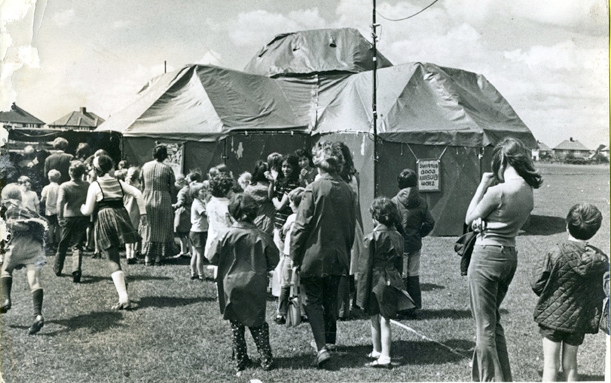


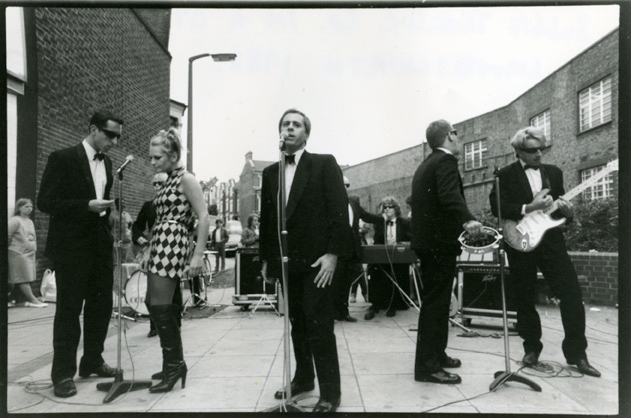


Company Work and Process: In 1971, the Greater London Arts Association set up a working party to look into the lack of theatre provision in the outer London Boroughs. The idea of a touring theatre was proposed to Glen Walford who was an Associate Director at the Royal Court. Glen had the idea of taking their own theatre, a portable structure, to the parks. Hear Glen Walford talking about the company’s origins. It would arrive like ‘a bubble’ and float off (Islington Gazette, 1979). The experience for the audience was to be affordable, informal and friendly. The shows would draw on popular culture, would be fun, colourful with plenty of music. A pattern developed of two main shows, one commissioned and one classic, a late night show and a children’s show. The first show was The London Blitz Show which Frank Hatherely researched and provided a rough scene order for. Glen and the company ‘fashioned a warm and vibrant show’ (Programme, 1973). The cast made further adaptations in response to the localities in which they performed. It was an informal musical documentary, being nostalgic for older people and informative for the younger generation. Staged in the round, audiences were involved in tasting food, entering a competition and singing. This show was formerly scripted for other companies to perform. The ‘Classic’ plays were freely adapted, often updated with colourful costumes, with the use of visual theatre and much music. A lively Bubble house style developed. Read about Working at Bubble.
Bubble continued touring the parks in the summer until 1983 when they were required by their funders to encourage communities to become more involved in theatre making. As well as the summer tours, they ran year- long programmes on three estates providing workshops in theatre skills to all ages. They also staged community events, for example The Golden Sole. This was an event which celebrated Thamesmead’s eighteenth year in 1985. Bubble had been working on the estate the year before with various community groups. Initially all the performers were involved in the workshops in their outreach work but in 1986, when Peter Rowe took over, he established a project team which included Deborah Bestwick, (who later became the Director of OvalHouse) Danny Braverman and Tony Gouveia, to carry out participation work. Adrian Jackson also developed work on homelessness and later left to form Cardboard Citizens. Peter’s first job after leaving university was to work with Inter-Action at the Almost Free theatre and with various community arts projects and had an understanding of this area of work. In 1986, they involved over two hundred people in The Golden Plot as part of Bermondsey Community festival. This move to working with the community has been an important strand in Bubble’s work up to the present day. Read more about Participatory theatre.
In 1989, Jonathan Petherbridge took over as Artistic Director and took the touring work out of the tent, into the open air and established promenade performances. He wrote and directed several pantomimes. Jonathan has continued involving the community with classes, training and work in schools. He has produced plays with community actors often focusing on inter-generational work in a variety of venues.
Personal appraisal and thoughts:
Glen Watford set out to provide theatre that was an event. ‘We saw the raising of the tent as all part of the spectacle – the circus coming to town’. She also wanted to break down the formal relationship between performers and theatre. At the first production, The London Blitz Show, she said she ‘had never seen anything like it before, people brought their kids, their dogs, their shopping. They weren’t scared to hiss and boo.’ (Islington Gutter Press, 1979). By 1979 Bubble had built up a following and ‘groupies turned up to buy the costumes that were being auctioned off at the end of the season.’ ‘People know it’s going to be exciting…we could be doing the yellow pages from a telephone directory for all they know and they still come.’ (Islington Gazette, 1979) Since people of a wide variety of social and cultural backgrounds came because they enjoyed the Bubble house style, Glen spoke of the need to ‘work on many levels: simply, colourfully, musically and amusingly yet with many layers of subtlety which can either be absorbed or rejected’ (Plays and Players, 1979). Glen did not think of Bubble as a fringe, community or an alternative theatre company. ‘It is no such thing, we’re a rep – only a travelling one. People want to be entertained, to see pretty girls and bright costumes, to hear catchy tunes and to follow a story which grips them and holds their interest’. (The Stage, 1979).
Peter Rowe, who took over in 1986, thought that Bubble was ‘alternative’. ‘Its whole purpose was to reach people who didn’t normally go to the theatre… to demystify theatre. The repertoire was not particularly radical… it was popular theatre in the best sense’ (Unfinished Histories interview 11th Mar, 2013).
Two plays which Peter directed could be termed ‘political’: I Fought the Yuppie Zombies from Hell (1988) by Alan Gilbey was a response to the re-development of the docks in Bermondsey and The Headless Body (1987) by Bryony Lavery was an anti-Thatcher metaphor. Hear Peter talking about these productions.
Peter agreed that the participation work could be regarded as ‘more political’ as its content was ‘dictated by the participants…about what concerned them’. Peter felt that there was a tension or contradiction between being a touring company and long-term engagement with the communities. Work in Rotherhithe, where Bubble has been based since 1986, was successful but Peter wonders what lasting legacy was left in some areas. Bubble was good at ‘galvanising’ a place – he remembers doing Plays in a Day with Danny Braverman in which a play was produced with community groups from nothing.
Although Artistic-Director led, Peter encouraged a collaborative approach and hoped the he was a ‘benevolent dictator’. There were no stars and everyone had to ‘muck in’, particularly with raising and striking the tent.
Peter remembers the ‘best of times’ and the ‘worst of times’ at Bubble.’ ‘It could be fantastic when the sun was shining and you had a full tent, the ground was firm under foot, it couldn’t be better’. There were lots of ‘highs and ‘fantastic shows’. It could be ‘horrendous’ when they had to spend a whole evening protecting the tent with the help of the police.’ Peter remembers the ‘sodden fields’ with wellies getting lost in the mud’ between the dressing room trailer and the tent.
Bubble had an important influence on Peter. He enjoyed the idea of theatre as an event- the feelings of excitement that this engendered. He liked and has continued working with actor-musicians and has developed his skills in musical theatre. The ‘direct address’ to the audience has informed his subsequent work.
Reviews:
The London Blitz Show (1972)
‘The whole event is affectionate, strictly apolitical and unashamedly soft-centred… the theatrical effects are kept to a minimum and are all the better for that: a striptease to ‘Hang Out Your Washing on the Siegfried Line’ is crucially interrupted by an air-raid.’ (Michael Coveney, Financial Times, 4th May 1972)
‘…a jolly concoction of songs and sketches supposedly staged in an air-raid shelter by a group of bomb-scared Londoners…it relies too heavily on a cosy sentimental nostalgia… the show could profitability be more stringent…Nevertheless the occasion itself is a remarkable one: a Hackney square filled by night with a sense of genuine communal festivity.’ (Michael Billington, The Guardian, 1972)
The Silver Jubilee Show (1977)
‘A highflying, free-wheeling show [in which] a salesman promotes his brand image of New Improved Monarchy…Her replica Highness is serenely played by Elaine Loudon… there is a gorgeous chorus of Corgis…’ (Donald Madgewick, Epsom and Ewell Advertiser,14th July, 1977)
Read more reviews here.
Productions:
| PRODUCTION NAME | VENUES | DATES |
|---|---|---|
| The London Blitz Show Writer: Frank Hatherley (devised) and compiled by the company Director: Glen Walford Cast: for the 1972 productions were drawn from the following pool of actors - Paul Blake, Mary Cunningham, Harry Ditson, Graham Gluck, Pauline Kelly, Helen Kruger, Stewart Preston, Francis Sargent, Fiona Victory, Maggie Wilkinson, Barry Wilmore Design: Constantios Corovilas | Touring parks in 22 London Boroughs | 1972 |
| Double Bubble Writer: James Saunders Director: Phil Partridge Cast: see 1972 productions above | as above | 1972 |
| Three in a Bubble Cast: see 1972 production above | as above | 1972 |
| The London Blitz Show | Touring parks in Hackney, Lewisham, Islington, Hammersmith, Sutton, Enfield, Wandsworth Ealing, Hillingdon Camden, Redbridge | 1973 |
| Jack the Ripper Show Writer: Frank Hatherley (devised) and compiled by the company Director: Glen Walford Design: Amanda Colin | as above | 1973 |
| In His Own Write Writer: John Lennon Director: Glen Walford Design: Claire Lyth | Touring parks in Hackney, Lewisham, Islington, Hammersmith, Sutton, Enfield, Wandsworth Ealing, Hillingdon Camden, Redbridge | 1973 |
| The London Pub Show Director: Phil Partridge Design: Claire Lyth | as above | 1973 |
| The Adventures of Boffy (children) | as above | 1973 |
| Custard, Liquorice and Cornflakes (children) | as above | 1973 |
| Triple Bill | as above | 1973 |
| Under Milk Wood Writer: Dylan Thomas Director: Ian Giles Cast: for the 1974 productions were drawn from the following pool of actors -Diane Barrett, Brenda Bleythn, Gillian Brailey, Kenneth Drury, Paul Felber, Mike Harley, John Judd, Anthony Rowlands Andrew Whitfield Design: Diana Greenwood | Touring parks In Hackney, Lewisham, Islington, Hammersmith, Sutton, Enfield, Wandsworth Ealing, Hillingdon Camden, Redbridge | 1974 |
| Jack the Ripper Show Director: Ian Giles Cast: see 1974 productions above Design: Diana Greenwood | as above | 1974 |
| The London Pub Show Writer: Shane Cannaughton and the company Director: Glen Walford Cast: see 1974 productions above Designer: Diana Greenwood Music: Jeremy Barlow | as above | 1974 |
| An Apple a Day Writer: John Antrobus Director: Glen Walford Cast: see 1974 productions above Design: Jon Halle | as above | 1974 |
| Kids Cabaret Writer: Ian Giles (devised) Director: Ian Giles Cast: see 1974 productions above Design: David Lewis | as above | 1974 |
| Cages Writer: Peter Coe (devised) Director: Peter Coe | Touring London Parks | 1975 |
| Story Theatre (children) | as above | 1975 |
| The Great Exhibition | as above | 1975 |
| The Trial of Marie Stopes | as above | 1975 |
| The Last Minute Show | as above | 1976 |
| The Mask of Satan | Touring London Parks | 1976 |
| The Witch and the Circus (children) | as above | 1976 |
| The Beggar's Opera Writer: John Gay Director: Glen Walford Cast: for the 1977 productions were drawn from the following pool of actors and actor-musicians - Colin Simms, Chris Hauke, Hugh Trethowan, John Ashton, Tina Jones, Elaine Loudon, Bill Marks, James Griffin, Christine Reynolds, Glen Watford Music: Ian Milne | as above | 1977 |
| The Silver Jubilee Show Writer: Glen Watford, Mike Maynard and the company Director: Glen Watford Music: Rick Lloyd Lyrics: Rick Lloyd Cast: see 1977 productions above | as above | 1977 |
| The Golden Samurai (children) Writer: Geoffrey Case Director: Adrian Harris Cast: see 1977 productions above Music: Ian Milne | as above | 1977 |
| Lady Audley's Secret Cast: see 1977 productions above | Touring London Parks | 1977 |
| A Midsummer Night's Dream | as above | 1978 |
| The Beggar's Opera Writer: John Gay | as above | 1978 |
| Gary Fogerty and the Devil's Circus (children) Writer: John Hartoch and the company Director: John Ashton | as above | 1978 |
| The Bubble Band Show Writer: Ian Milne (devised) | as above | 1978 |
| The Minstrel, the Witch and the Wicked Duke (children) Writer: Adrian Harris and the company | Touring London Parks | 1978 |
| Kiss Me Quick Writer: Michael Maynard and the company | Ravenscourt Park, Blackheath, Cheam Park, Harefield Green, Southall, Feltham Green, Hendon Fields, Highbury Fields | 1978 |
| Twelfth Night Director: Glen Walford Cast included: Andy readman, Neil Boorman, Lewis Cowen, Barbara Thorne, Stuart Milligan, Stephen Rayne Design: Elaine Garrard | Touring London Parks | 1979 |
| Two Lads from London Writer: Kevin Robinson (adapted from the Beau Strategem) | as above | 1979 |
| The Goose Girl (children) Writer: Kevin Robinson Director: Kevin Robinson Cast:Sue Shattock, Neil Boorman, Glen Watford/Barbara Thorn, Keith Woodhams, John Benfield Design: David Short Music: Ian Milne | as above | 1979 |
| Hero of the Gods Writer: John Ashton Director: John Ashton Cast: Stuart Milligan, Barbara Thorn, Stephen Rayne, Janet Rawson | Touring London Parks | 1979 |
| The Knight at the Bubble Writer: Rony Robinson, Director: Bob Carlton Music: Paul Abrahams | as above | 1980 |
| Mario's Magnificent Marvels (children) Writer: Philip Whitchurch Director: Philip Whitchurch Design: Claire Lyth | as above | 1980 |
| They Shoot Horses, Don't They? Writer: Roy Herman Director: Bob Carlton Cast: Gary Oldman, Philip Whitchurch, John Markham, Roger Rowland, Karen Mann, Metin Marlow, Alwynne Taylor, Lill Roughley, Phillipa Davies Design: Claire Lyth | as above | 1980 |
| Big Shot:The Rise and Rise of Catgut Leone (children) Writer: Paul Allen Director: Bob Carlton Design: Claire Lyth Music: Paul Abrahams | as above | 1980 |
| Three Days and a Porridge Writer: Philip Whitchurch Director: Bob Carlton Design: Sue Mayes | Touring London Parks | 1980 |
| The Five and a Half Labours of Arnold | as above | 1980 |
| Happy End Writer: Bertolt Brecht Director: Bob Carlton Cast: Billy Hughes, Richard Cary, Terry John, Aletta Lawson, Clive Corner, Anne Miles, Eve Adam | as above Chichester Festival Theatre | 1981 |
| Dracula Writer: Ken Hill Director: Philip Whitworth | Touring London parks | 1981 |
| The Tales of the Mountain and the Moon (children) | as above | 1981 |
| The Crown and the Crimson Dagger | Touring London Parks | 1981 |
| The Taming of the Shrew | as above | 1982 |
| Glitterballs Writer: Stephen Wyatt Cast included: Richard Blain, Clive Corner, Matthew Devitt | as above | 1982 |
| The Hubble Bubble Band Show. Writer: Joe Darlison Cast: Nicky Furse, Richard Blain, John Ashby, Anne Miles, Clive Corner | as above Also Rotherhithe Civic Centre Albion Street and Café Encore, Panton Street, SW1 | 1982 |
| The Further Adventures of Bungalow Bill (children) Writer: Rony Robinson Cast: included Karen Mann, Colin Wakefield | Touring London Parks | 1982 |
| Runaround Sue | Street theatre in Wandsworth | 1982 |
| The Return to the Forbidden Planet Writer: Joe Darlison | Touring London parks | 1983 |
| Rogue's Progress Writer: Stephen Wyatt Cast: included Kate Edgar, Nicky Furre | as above | 1983 |
| Under the Hills and Far Away (children) Writer: John Curry | as above | 1983 |
| Pick Yourself Up Writer: Stephen Wyatt | as above | 1983 |
| Hell Can Be Heaven Writer: Hereward K Cast included: Matt Devitt | Touring London Parks | 1983 |
| Duckin' 'n Divin Writer: Tunde Ikoli Director: Bob Eaton Cast: included Diane adderley, Winston Crooke, Lou Sexty, Jenny Bolt, Lyn Rees Music: Diane Adderley | as above | 1984 |
| Caucasian Chalk Circle Writer: Bertolt Brecht Director: Bob Eaton Cast: included Jenny Bolt, Winston Crooke, Lou Sexty | as above | 1984 |
| Frankie's Friends (children) | as above | 1984 |
| In the Groove Writer: Gillian Richmond | as above also East Greenwich Community Centre | 1984 |
| Thamesmead Tanzi Writer: Claire Luckham Director: Robert Swain Cast: Heather Goodman, Barry Gunner, Bob Eaton, Carole Rugier. Osaze Ehibor, Sakuntala Romanee, Mike O'Neill Design: Cath Fitzgerald | Touring London Parks | 1985 |
| Mummy Writer: Bob Eaton Director: Bob Eaton Cast: Bill Glasgow, Niki Tinenti, Robert Swain, Carole Ruggier, Barry Cunner, Sakauntala Romanee, Mike O'Neil, Paddy Cunneen, Kate Rankin Best. Music: Paddy Cuneen Design: Cath Fitzgerald | as above | 1985 |
| Out of the Video Box(children) Writer: Beryl King, Val Baxter and the cast Director: Val Baxter Cast: Carole Ruggier, Osaze Ehibor, Barry Gunner, Heather Goodman, Paddy Cunneen Design: Cath Fitzgerald | as above | 1985 |
| Late Night Live | as above | 1985 |
| The Golden Sole (a community production) | Thamesmead | 1985 |
| Blood Brothers Writer: Willy Russell Director: Peter Rowe | Blackheath, Downham, Bermondsey, Sutton, Hounslow, Ealing, Thamesmead | 1986 |
| Magical Powers for Twenty Four Hours (children) Writer: Tony Coult | as above | 1986 |
| Can't Pay, Won't Pay Writer: Dario Fo | as above | 1986 |
| The Golden Plot (community production) | Bermondsey | 1986 |
| Thamesmead Transformers (community production) | Thamesmead | 1986 |
| The Headless Body Writer Byrony Lavery Director: Peter Rowe Cast: Carole Russell, Jacqui-Lawrence David Urquhart, Lynn Whitehead, Steve Edwin, Nick Mercer, Liza Spenz | Touring London parks | 1987 |
| Wild Child (children) Writer: Shaun Prendergast Cast: David Urquhart, Carol Russell, Nick Mercer | as above | 1987 |
| The Cabaret of Dr. Caligari Writer: Alan Gilbey | as above | 1987 |
| Two Can Play Director: Peter Rowe Design: Paul Kondras Cast: Jacqui Gordon-Lawrence, Basil Otain | as above | 1987 |
| I Fought the Yuppie Zombies from Hell Writer: Alan Gilbey Director: Peter Rowe Musical director: Alan Ellis Cast: Sandra James Young, Liza Spenz, Simon Deacon, Kenneth Gardnier, Liz Kitchen, Jon Glentoran, Junior A. Walker, Conrad Schwarz, Sarah Davison | as above | 1988 |
| Gawain and the Green Knight (children) | Touring London Parks | 1988 |
| A Midsummer Night's Dream Director: Peter Rowe | as above | 1988 |
| Cabaret Country | as above | 1988 |
| Groping for Words Writer; Sue Townsend Director: Peter Rowe Cast: Steve Sweeney, Sandra James Young, Penny Jones, John Halstead | Watermans Arts Centre, Brentford, Cranford Community School, cranford | 1988 |
| Bobble Joe and the Buffalo Riders Cast: Conrad Schwarz, Liza Spenz, Liz Kitchen, Simon Deacon | Touring London Parks | 1988 |
Interviewee reference: Peter Rowe and Chris Hauke.
Links:
www.londonbubble.org.uk
www.glenwalford.com
www.chrishauke.com
Existing archive material: Images, scripts, production notes, minutes, correspondence, finance, newspaper cuttings and publicity housed at London Bubble from 1972 onwards.
Bibliography:
Castles in the Air by Tony Rowlands, University College of Swansea, 1985 (in Bubble archive)
The London Bubble by Jacqueline McNerney, Diploma in Arts Administration, Roehampton Institute, 1986 (in Bubble archive)
Alternative Theatre Directory edited by Catherine Itzin, (Eyre Methuen 1979)
Mixed Fancies, Brenda Bleythn (Simon and Schuster 2006)
Acknowledgements: This page was created by Iris Dove with the help of London Bubble Theatre Company, Peter Rowe and Chris Hauke. November 2013
The creation of this page was supported by the National Lottery through the Heritage Lottery Fund.